NEET UG Counselling 2026: Your Complete Guide to Medical College Admission. NEET UG Counselling is the admission process conducted by the Medical Counselling Committee (MCC) for allocation of MBBS, BDS, AYUSH, and veterinary seats in government, private, and deemed universities across India. The counselling process involves registration, choice filling, seat allotment, and reporting to allotted colleges based on NEET UG scores and preferences.
What is NEET UG Counselling?
NEET UG Counselling is a centralized online admission process that allocates medical and dental seats to qualified NEET candidates. The Medical Counselling Committee conducts counselling for All India Quota (AIQ) seats, while individual states conduct their own counselling for state quota seats. This systematic process ensures fair and transparent admission to medical courses based on merit and reservation policies.
The counselling process typically begins 2-3 weeks after NEET results are declared and continues through multiple rounds until all available seats are filled. Students can participate in both central and state counselling simultaneously, providing maximum opportunities for admission.
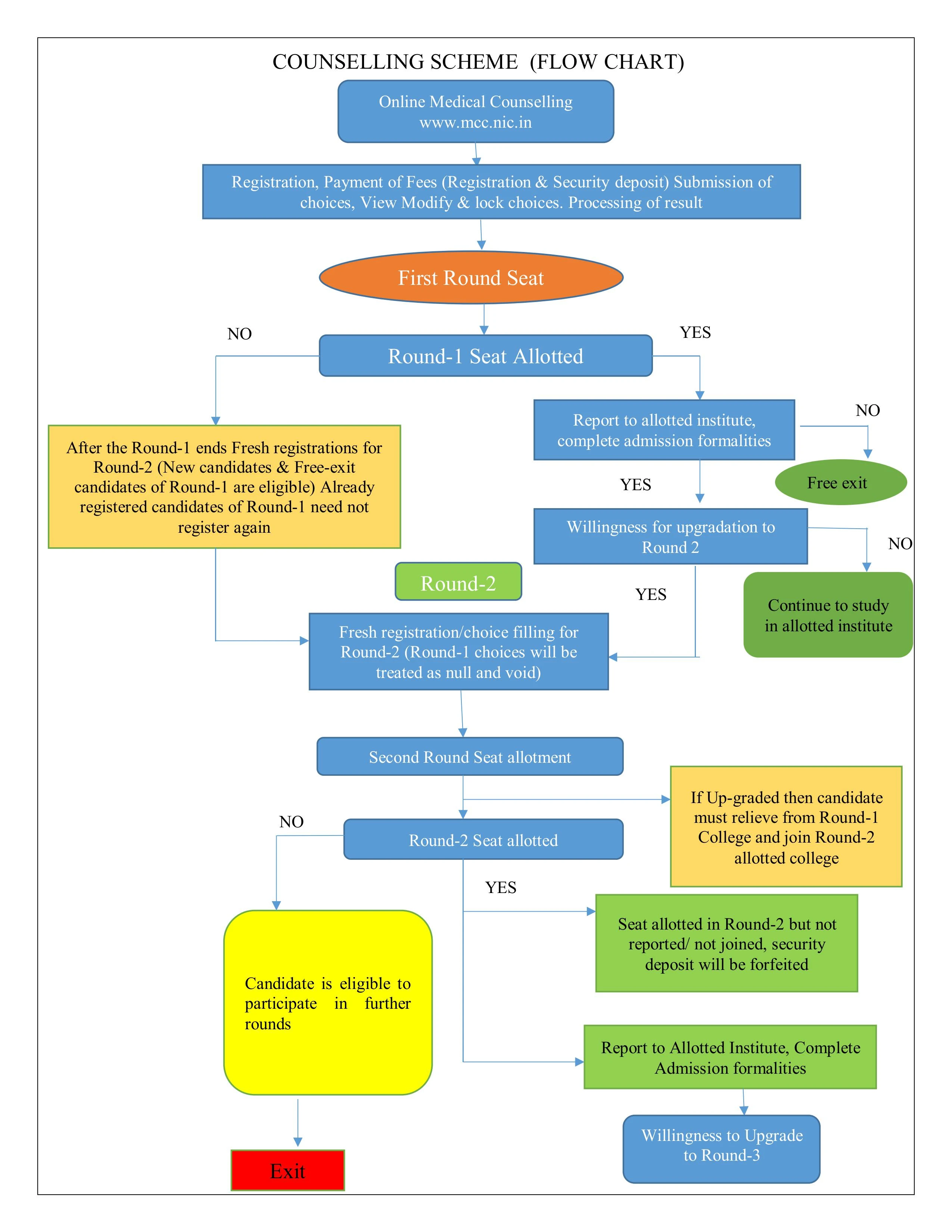
NEET UG Counselling Process Overview Flowchart
Table of Contents
1. Understanding NEET UG Counselling Process
2. Types of NEET Counselling (AIQ vs State)
3. Eligibility Criteria for NEET Counselling
4. Registration Process Step-by-Step
5. Documents Required for Counselling
6. Choice Filling and Locking Process
7. Seat Allotment Mechanism
8. Counselling Rounds Explained
9. Reporting and Admission Process
10. Fee Structure and Payment
11. Upgradation and Exit Options
12. State-wise Counselling Details
13. Private and Deemed University Counselling
14. Common Mistakes to Avoid
15. Expert Tips for Success
Understanding NEET UG Counselling Process
The NEET UG counselling process is designed to provide equal opportunities to all qualified candidates for admission to medical and dental courses. The entire process is conducted online, making it accessible to students across India, including those from Chandigarh, Punjab, Haryana, and Himachal Pradesh.
How NEET Counselling Works
NEET counselling operates on a merit-cum-preference basis. Your NEET rank determines your priority in seat allocation, while your filled choices determine which colleges and courses you're considered for. The computer-based algorithm allocates seats by checking each candidate's preferences in order and assigning the best available option.
Expert Tip: Understanding the counselling mechanism helps you make strategic choices. Always fill choices in order of your genuine preference, as the system will allocate the highest preference available to you.
The process involves several sequential steps:
- Registration and payment of counselling fees
- Choice filling of colleges and courses
- Seat allotment based on rank and preferences
- Reporting to allotted institute within specified time
- Document verification and fee payment
Timeline and Schedule
NEET UG Counselling 2026 typically follows this timeline:
Phase 1: Registration (July)
- Online registration opens
- Document upload and verification
- Fee payment
Phase 2: Choice Filling (July-August)
- College and course selection
- Choice rearrangement
- Final locking of choices
Phase 3: Seat Allotment (August-September)
- Round 1 result declaration
- Reporting and admission
- Round 2 and subsequent rounds
NEET Counselling Schedule and Important Dates
Types of NEET Counselling: AIQ vs State Quota
Understanding the difference between All India Quota (AIQ) and State Quota counselling is crucial for maximizing your admission chances. Both processes run simultaneously, allowing eligible candidates to participate in both.
All India Quota (AIQ) Counselling
AIQ counselling is conducted by MCC for 15% seats in government medical colleges and 100% seats in central institutions like AIIMS, JIPMER, ESIC, and AFMC. This counselling is open to candidates from all states and provides opportunities nationwide.
AIQ Seat Distribution:
- Government Medical Colleges: 15% of total seats
- Central Universities: 100% of seats
- ESIC Medical Colleges: 100% of seats
- Armed Forces Medical College: 100% of seats
- Deemed Universities: As per university policy
Eligibility for AIQ:
- All Indian nationals who qualified NEET
- No domicile restrictions
- Age criteria as per NMC guidelines
State Quota Counselling
State quota counselling covers 85% seats in government colleges and varying percentages in private colleges within each state. Each state conducts its own counselling with specific eligibility criteria.
State Quota Features:
- Domicile requirements vary by state
- Reserved categories as per state policies
- Different fee structures
- Local language preferences in some states
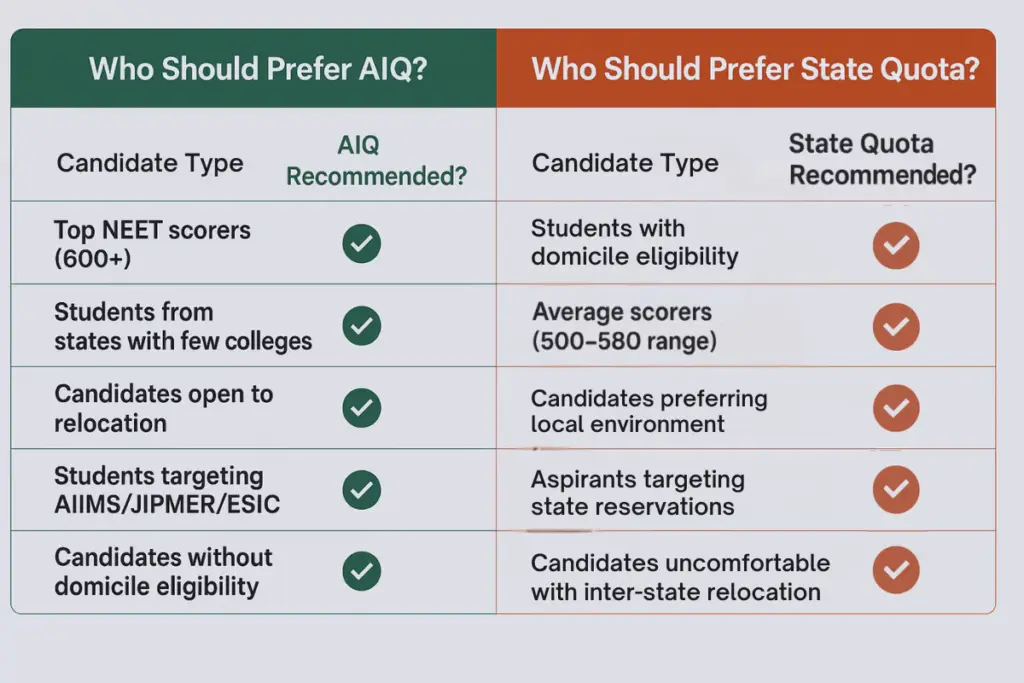
NEET UG AIQ vs State Quota Comparison Chart
| Aspect | All India Quota | State Quota |
|--------|----------------|-------------|
| Conducted By | Medical Counselling Committee (MCC) | State Authorities |
| Seats Covered | 15% Govt + 100% Central | 85% Govt + Private |
| Domicile Required | No | Yes (varies by state) |
| Competition Level | National | State-level |
| Fee Structure | Uniform | State-specific |
Common Mistake: Many students assume they can only participate in one type of counselling. You can and should participate in both AIQ and state counselling if eligible.
Eligibility Criteria for NEET Counselling 2026
Before registering for NEET UG counselling, ensure you meet all eligibility requirements. Missing any criterion can lead to disqualification even after seat allotment.
Basic Eligibility Requirements
Academic Qualifications:
- Passed 12th with Physics, Chemistry, Biology/Biotechnology, and English
- Minimum 50% aggregate marks (40% for SC/ST/OBC, 45% for PWD)
- Must have qualified NEET UG 2026
Age Criteria:
- Minimum age: 17 years as of December 31, 2026
- Maximum age: 25 years for General/EWS (30 for SC/ST/OBC)
- No upper age limit for PWD candidates
Nationality:
- Indian citizens
- NRI candidates (specific seats available)
- OCI/PIO candidates (as per guidelines)
Category-wise Eligibility
The reservation system in NEET counselling follows constitutional provisions and NMC guidelines:
General Category: Open competition based purely on merit
EWS (10%): Annual family income below ₹8 lakhs
SC/ST (15% + 7.5%): Valid caste certificate required
OBC-NCL (27%): Non-creamy layer certificate mandatory
PWD (5%): Minimum 40% disability certificate
National Medical Commission (NMC)
Important Note: Ensure all certificates are from competent authorities and within validity periods. Invalid documents lead to immediate disqualification.
State-specific Requirements
Different states have additional eligibility criteria for state quota counselling:
Punjab NEET Counselling:
- 15 years continuous residence in Punjab, OR
- Studied classes 10, 11, 12 in Punjab, OR
- Parents domiciled in Punjab for 15 years
Haryana NEET Counselling:
- Domicile certificate from competent authority
- Character certificate from school/college
- Categories: Resident, Non-resident Haryanvi
Himachal Pradesh NEET Counselling:
- Himachali Bonafide certificate
- Special provisions for border area students
- Specific documents for different categories
Registration Process Step-by-Step
NEET UG counselling registration is the first crucial step toward securing admission. The process is entirely online and requires careful attention to detail.
Step 1: Online Registration
Visit the official MCC website and complete the registration process:
1. Create Account
- Enter NEET roll number and date of birth
- Generate login credentials
- Verify through OTP
2. Personal Details
- Fill accurate personal information
- Enter NEET scorecard details
- Select category and quota
3. Contact Information
- Provide valid mobile number
- Enter active email address
- Complete address details
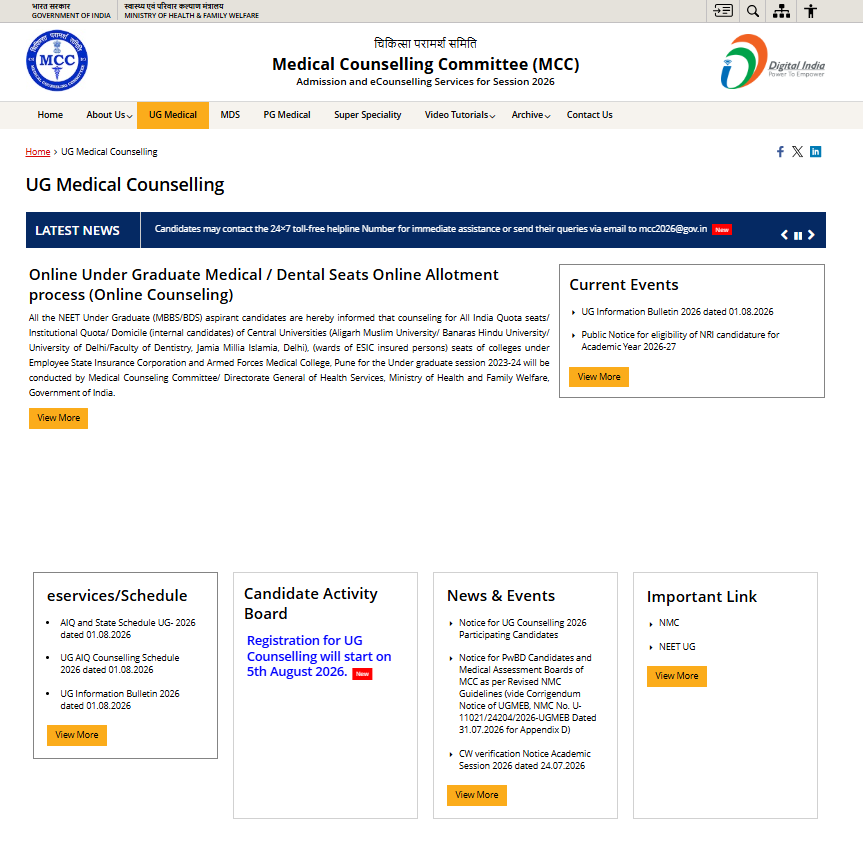
NEET Counselling Registration Portal Screenshot
Step 2: Document Upload
Upload high-quality scanned documents in specified format:
Mandatory Documents:
- NEET admit card and scorecard
- Class 10 and 12 mark sheets
- Date of birth certificate
- Category certificate (if applicable)
- ID proof (Aadhaar/Passport/Voter ID)
Document Specifications:
- Format: PDF or JPG
- Size: Maximum 1MB per document
- Resolution: Minimum 200 DPI
- Color: Colored scans preferred
Expert Tip: Keep digital copies ready before starting registration. Poor quality documents often lead to verification issues and delays in the admission process.
Step 3: Fee Payment
Pay the counselling fee through online mode:
Fee Structure 2026:
- General/EWS: ₹1,000
- SC/ST/OBC/PWD: ₹500
- Payment modes: Net banking, Credit/Debit cards, UPI
Important: Keep multiple payment receipts and transaction IDs. Fee payment confirms your registration and enables choice filling.
Step 4: Verification Process
After successful registration and fee payment:
1. Auto-verification: System checks basic document authenticity
2. Manual verification: Complex cases reviewed by officials
3. Status update: Check regularly for verification status
4. Correction window: Limited time to correct errors
Documents Required for NEET Counselling
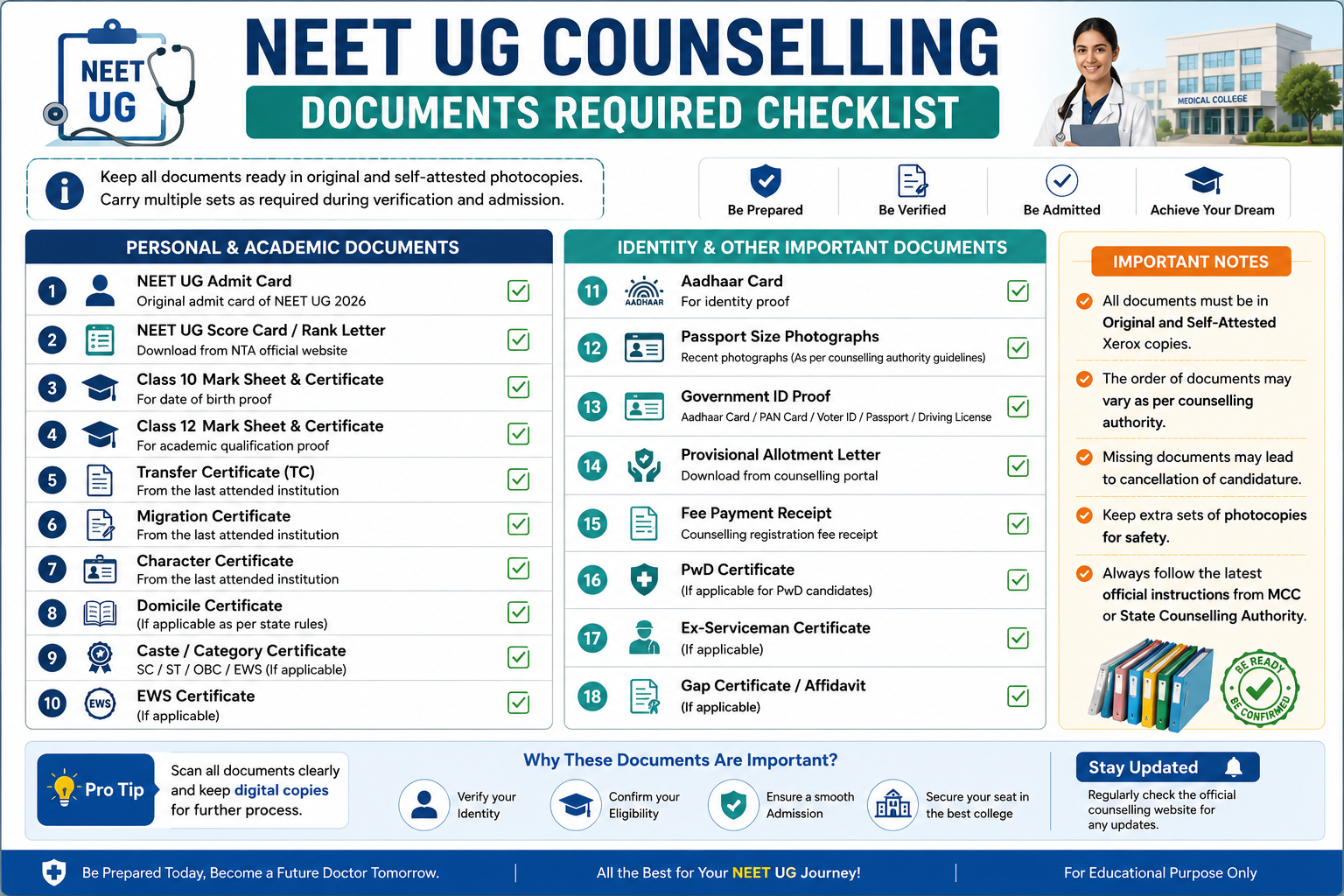
Proper documentation is critical for successful counselling participation. Missing or invalid documents can result in disqualification at any stage.
Essential Documents Checklist
Academic Documents:
✓ NEET 2026 admit card and scorecard
✓ Class 10 certificate and mark sheet
✓ Class 12 certificate and mark sheet
✓ Migration certificate (if from different board)
✓ Character certificate from school
Identity Proof:
✓ Aadhaar card (mandatory)
✓ Passport (if available)
✓ Voter ID card
✓ Driving license (additional proof)
Category Certificates:
✓ Caste certificate (SC/ST/OBC)
✓ EWS certificate (if applicable)
✓ PWD certificate with medical board approval
✓ Non-creamy layer certificate for OBC
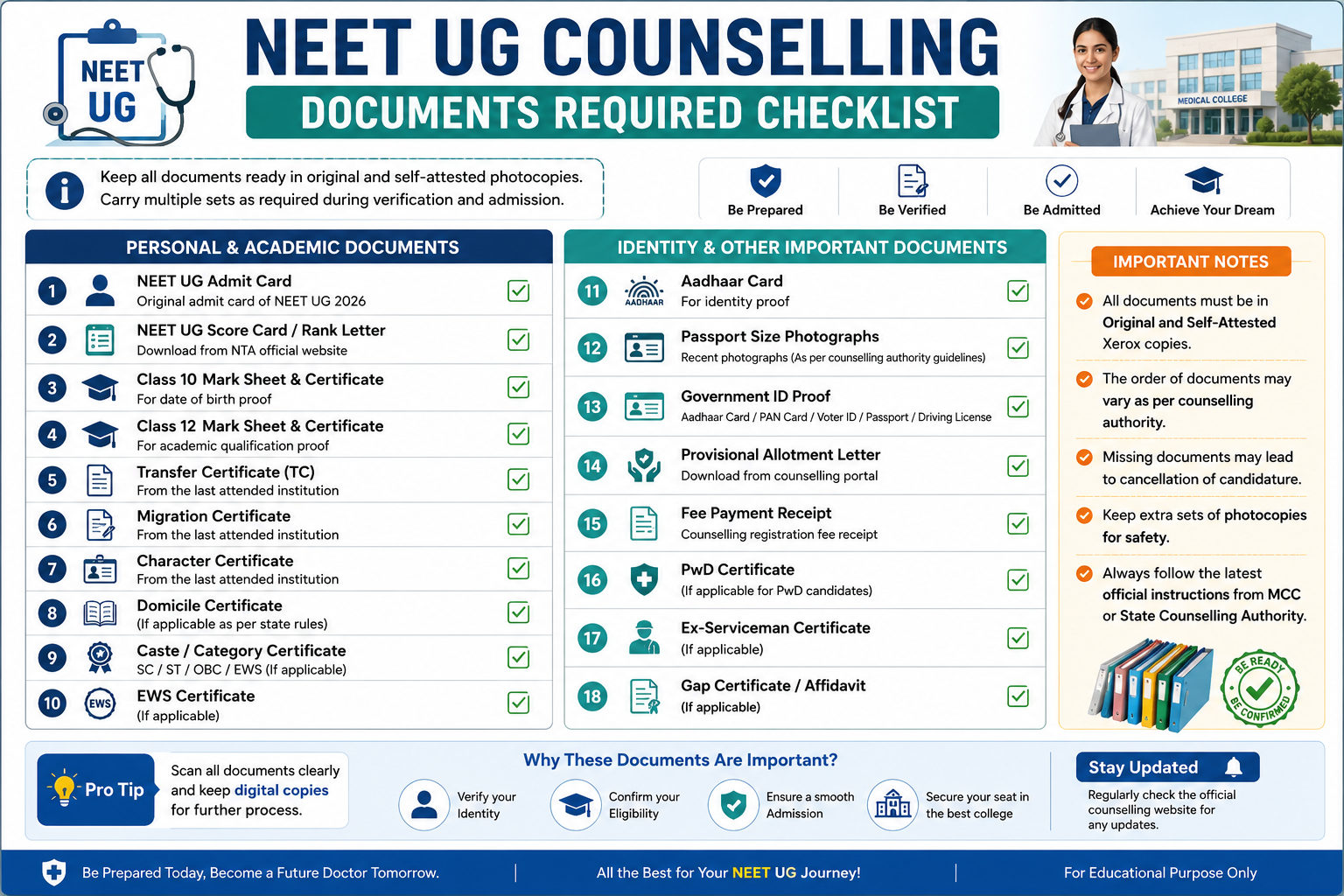
NEET UG Documents Required Checklist Infographic
State-specific Additional Documents
Different states require additional documentation for state quota counselling:
For Punjab Candidates:
- Punjab domicile certificate
- Punjabi language studied certificate (if claiming language quota)
- Border area certificate (if applicable)
For Haryana Candidates:
- Haryana domicile certificate
- Mewat area certificate (if applicable)
- Income certificate for fee concessions
For Himachal Pradesh Candidates:
- HP domicile certificate
- Tribal area certificate (if applicable)
- BPL certificate (if claiming economic reservation)
Document Authenticity and Validity
Important Guidelines:
- All certificates must be original during physical verification
- Caste certificates valid for current academic year only
- Income certificates dated within current financial year
- Medical certificates for PWD category within specified validity
Common Mistake: Using outdated certificates or photocopies during physical verification. Always carry original documents and ensure all certificates are current.
Document Verification Guidelines
Choice Filling and Locking Process
Choice filling is the most critical aspect of NEET counselling, as it determines your admission possibilities. Strategic choice filling can significantly improve your chances of getting preferred colleges and courses.
Understanding Choice Filling
Choice filling involves selecting and arranging colleges and courses in order of preference. The seat allotment algorithm checks your choices sequentially and allocates the highest available preference based on your rank.
Key Principles:
- Fill choices in genuine preference order
- Consider both college and course preferences
- Include safe options alongside dream choices
- Research thoroughly before making selections
Strategic Choice Filling Approach
1. Dream Choices (Top 20-30 choices)
Include colleges you aspire for, even if chances seem low. NEET counselling can have surprises, and you might get a seat if other candidates don't report.
2. Realistic Choices (Middle 40-50 choices)
Focus on colleges where your rank has reasonable chances. Analyze previous year cutoffs and trends.
3. Safe Choices (Last 30-40 choices)
Include colleges where admission is almost certain based on your rank. This ensures you don't miss out on admission entirely.
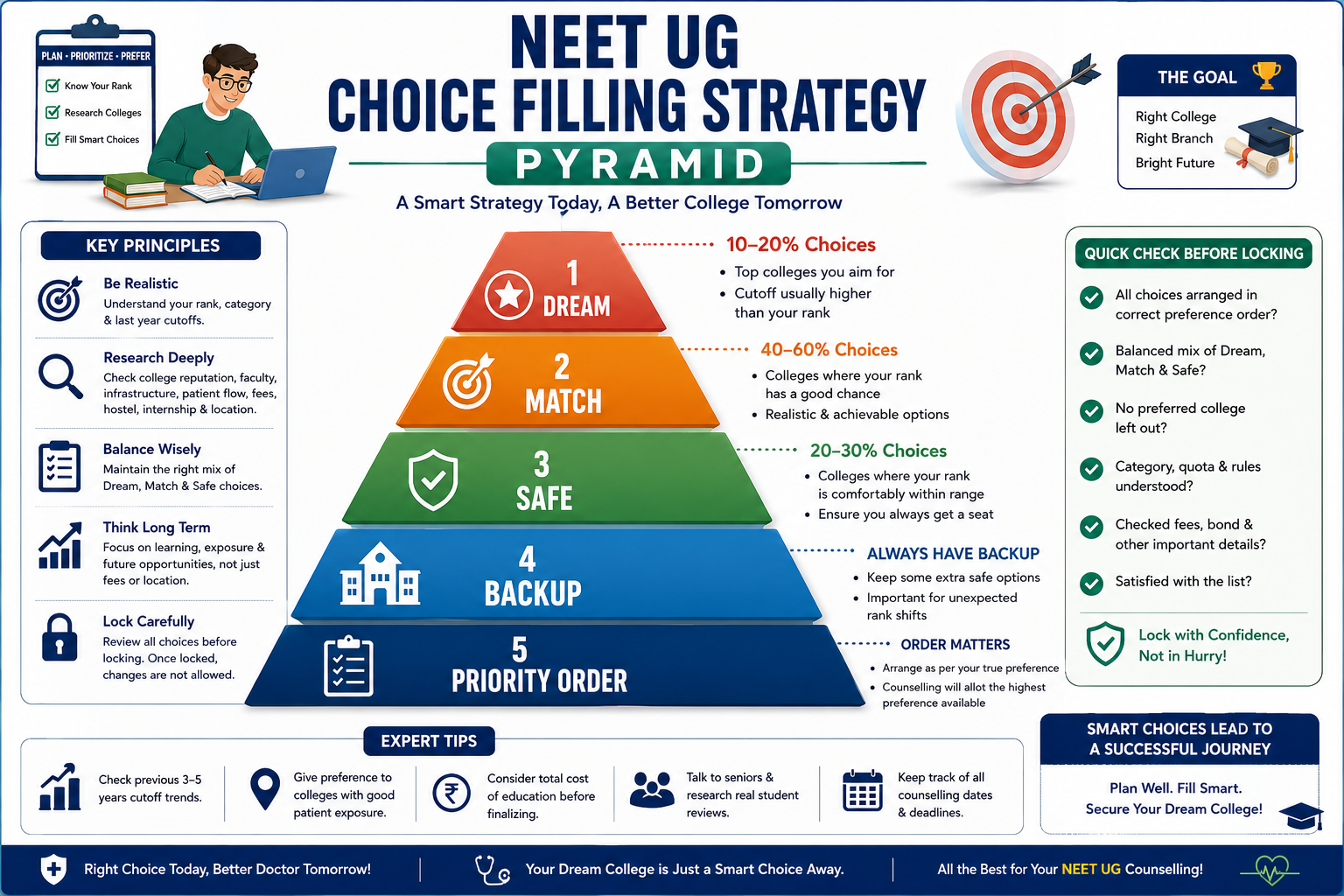
NEET UG Choice Filling Strategy Pyramid
College Research and Analysis
Before filling choices, conduct thorough research:
Factors to Consider:
- Previous year cutoff ranks
- College infrastructure and facilities
- Faculty qualifications and experience
- Hospital bed strength for clinical exposure
- NEET PG passing rates and results
- Location and connectivity
- Fee structure and additional costs
Research Tools:
- Official college websites
- NMC database of approved colleges
- Previous year counselling data
- Student reviews and feedback
Expert Tip: Students from Chandigarh, Mohali, and surrounding areas should consider both local institutions and colleges in neighboring states. Sometimes, colleges in Rajasthan, UP, or other states offer better opportunities despite being farther away.
Choice Modification and Locking
The choice filling process allows multiple modifications before final locking:
Modification Window:
- Add new choices anytime during the window
- Rearrange existing choices unlimited times
- Delete unwanted choices
- Research and reconsider options
Locking Process:
- Final submission of choice list
- No changes possible after locking
- Automatic locking at deadline if not done manually
- Confirmation through OTP verification
Important Note: Always lock your choices manually before the deadline. Auto-locking might not save your latest modifications, and you cannot change choices once locked.
Course-wise Choice Filling Strategy
MBBS Priority:
If MBBS is your primary goal, fill MBBS seats from all preferred colleges before considering BDS or other courses.
BDS Consideration:
Include BDS seats from good colleges, especially if you're open to dental careers. BDS from premier institutions often has better prospects than MBBS from low-ranking colleges.
AYUSH Courses:
Consider BAMS, BHMS, BUMS courses if you're interested in alternative medicine systems.
Seat Allotment Mechanism
Understanding the seat allotment algorithm helps you make informed decisions during counselling and subsequent rounds.
How Seat Allotment Works
The computerized seat allotment follows a systematic algorithm:
Step-by-Step Process:
1. Rank-wise Processing: Candidates processed in order of NEET ranks
2. Choice Checking: System checks each candidate's choice list sequentially
3. Seat Availability: Verifies if seats are available in preferred college/course
4. Category Verification: Confirms candidate's eligibility for available seat type
5. Provisional Allotment: Assigns seat if all conditions are met
6. Next Candidate: Moves to next rank holder
Algorithm Features:
- No candidate gets a choice lower than what they could have received
- Higher rank holders processed first
- Category-wise seat allocation maintained
- Reservation policies strictly followed
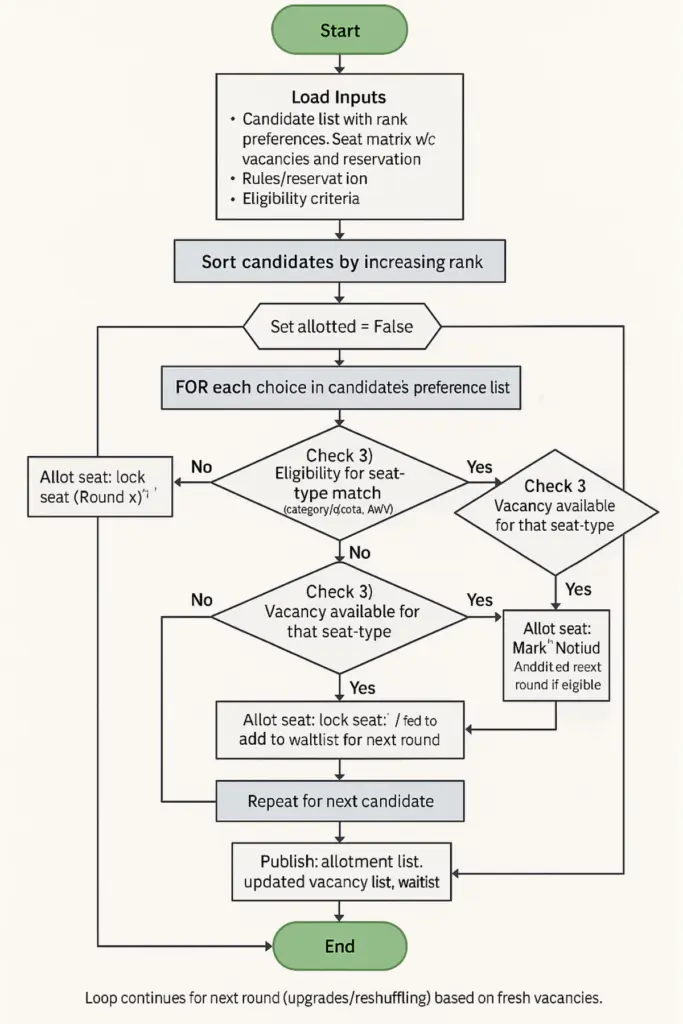
NEET UG Seat Allotment Algorithm Flowchart
Factors Affecting Seat Allotment
Primary Factors:
- NEET All India Rank (AIR)
- Category rank (if applicable)
- State of eligibility for quota
- Choice order and preferences
- Seat availability in preferred courses
Secondary Factors:
- Domicile status for state counselling
- Sub-category reservations (rural, women, etc.)
- Previous round choices and outcomes
- Upgrade preferences selected
Category-wise Seat Allocation
Seats are allocated following constitutional reservation guidelines:
Reservation Matrix:
- General: Open competition (remaining after reservations)
- SC: 15% of total seats
- ST: 7.5% of total seats
- OBC-NCL: 27% of total seats
- EWS: 10% of total seats
- PWD: 5% horizontal reservation across all categories
Important: If reserved category candidates qualify for general merit, they compete in the general pool, leaving reserved seats for other category candidates.
State-wise Variations
Different states have additional reservation policies:
Punjab Reservations:
- Scheduled Castes: 32%
- Backward Classes: 20%
- Border Area: 5%
- Sports: 2%
Haryana Reservations:
- Scheduled Castes: 20%
- Backward Classes: 27%
- Economically Weaker Sections: 10%
- Physically Handicapped: 3%
Himachal Pradesh Reservations:
- Scheduled Castes: 25%
- Scheduled Tribes: 7.5%
- Other Backward Classes: 27%
- Economically Weaker Sections: 10%
NEET Counselling Rounds Explained
NEET counselling is conducted in multiple rounds to ensure maximum seat utilization and provide multiple opportunities to candidates.
Round 1 Counselling
Round 1 is the primary counselling round where most seats are allocated:
Process Timeline:
- Choice filling: 5-7 days
- Processing and allotment: 2-3 days
- Result declaration: Specific date announced
- Reporting period: 5-7 days typically
Seat Allocation:
- All available seats participate
- Fresh allocation based on choices
- Best possible choice allocated to each candidate
- Category-wise allocation maintained
Reporting Options:
After Round 1 allotment, candidates have three options:
1. Report and Freeze: Accept the seat and exit counselling
2. Report and Upgrade: Secure the seat but remain eligible for upgrades
3. Not Report: Forfeit the seat and remain eligible for subsequent rounds
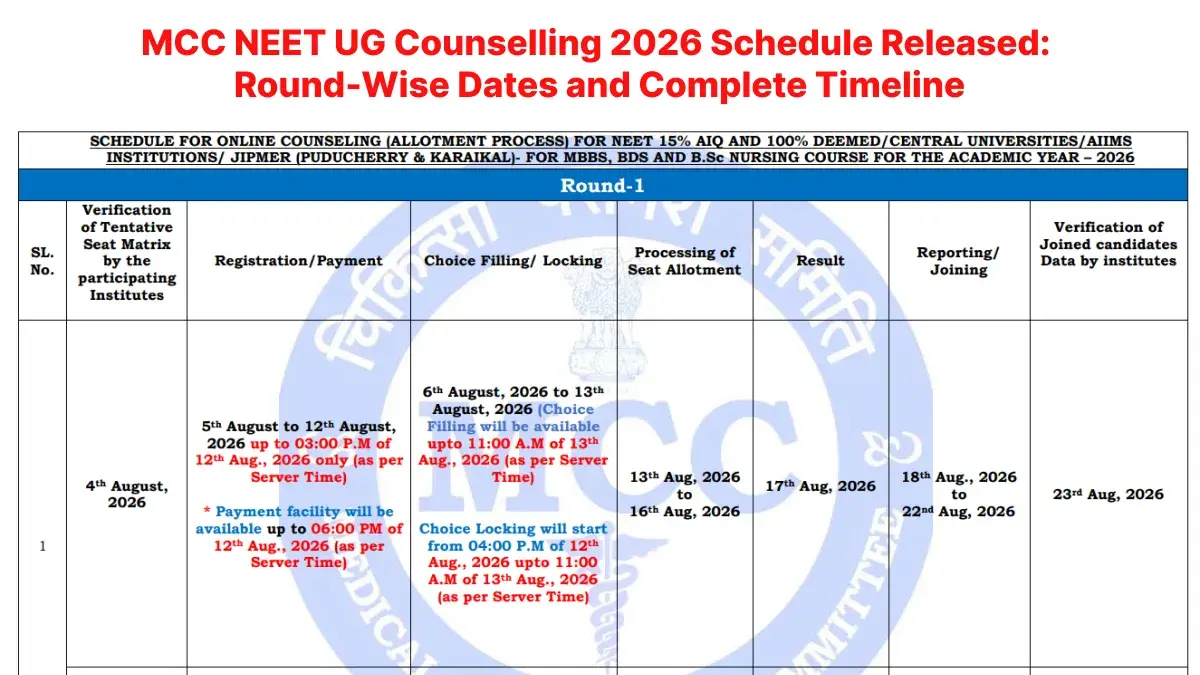
NEET UG Round 1 Counselling Timeline
Round 2 Counselling
Round 2 includes seats vacated after Round 1 and any additional seats:
Available Seats:
- Seats vacated by candidates who didn't report
- Seats left by candidates who got upgrades
- Any newly added seats by institutions
Eligibility:
- Candidates who didn't get seats in Round 1
- Candidates who chose upgrade option
- Fresh candidates (if registration reopened)
Strategy for Round 2:
- Analyze Round 1 cutoffs before choice filling
- Adjust expectations based on available seats
- Consider different colleges or courses
Mop Up Round
The Mop Up Round is conducted for remaining vacant seats:
Purpose:
- Fill maximum seats before academic session begins
- Provide last opportunity for admission
- Include deemed universities and private colleges
Characteristics:
- Open to all eligible candidates
- Limited seats available
- Competition often lower due to fewer participants
- Final opportunity for current year admission
Expert Tip: Don't underestimate Mop Up rounds. Many students get excellent colleges in these rounds as higher-ranked candidates often secure seats in earlier rounds and don't participate.
Stray Vacancy Round
Some states conduct additional stray vacancy rounds:
State-specific Process:
- Conducted by individual states
- Very limited seats available
- Often includes private colleges
- Last chance for state quota seats
Participation Strategy:
- Monitor state counselling websites
- Quick decision-making required
- Be flexible with choices
- Consider it as bonus opportunity
Round-wise Counselling Strategy Guide
Reporting and Admission Process
Successful seat allotment is just the beginning. The reporting and admission process requires prompt action and proper documentation.
Reporting Timeline and Process
Immediate Actions After Allotment:
1. Download Allotment Letter: Available on counselling portal
2. Check Reporting Dates: Strictly adhere to timelines
3. Arrange Documents: Gather all required originals
4. Plan Travel: Book transportation to allotted college
Reporting Window:
- Usually 5-7 days from result declaration
- Specific dates mentioned in allotment letter
- No extensions typically granted
- Late reporting results in seat forfeiture
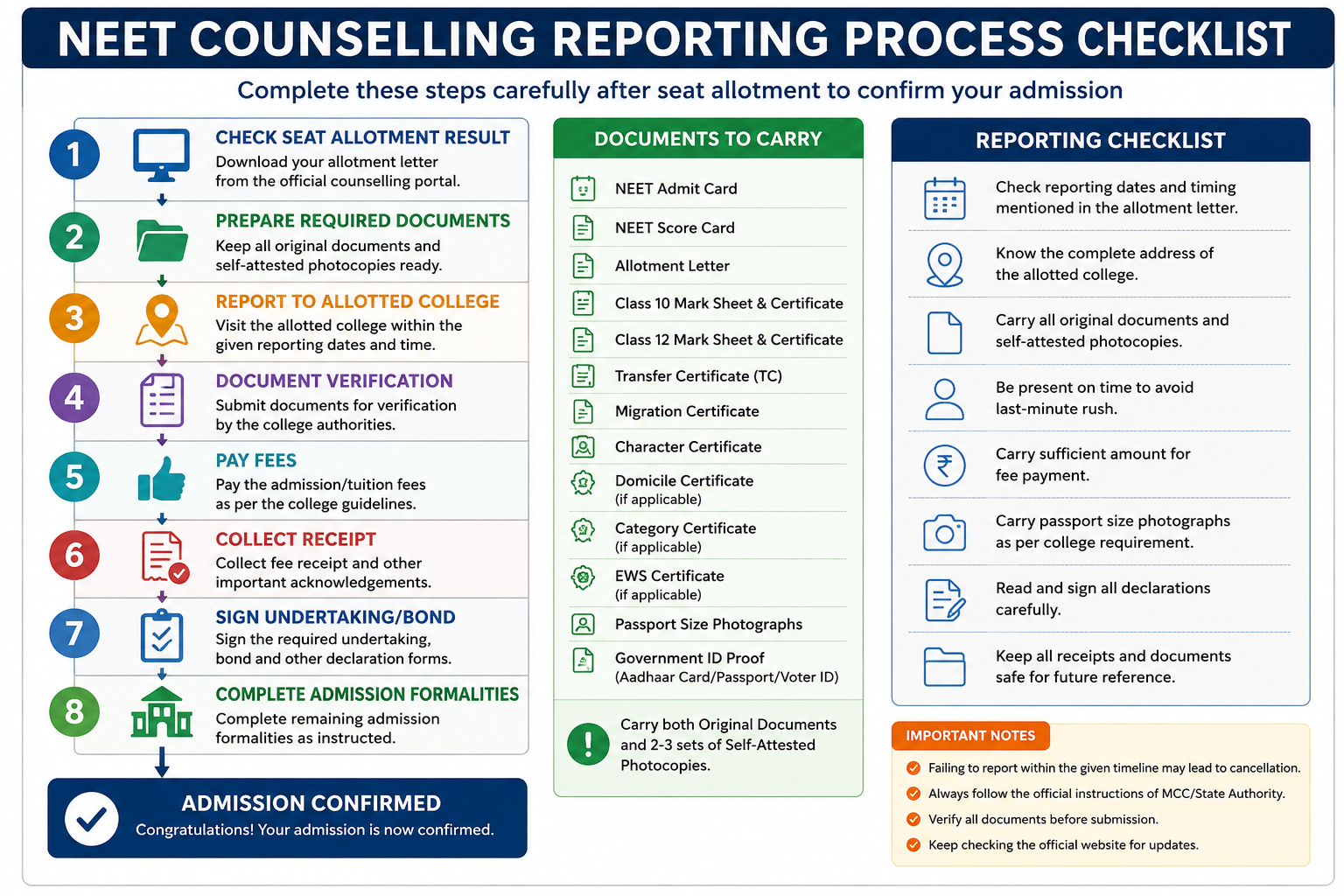
NEET UG Reporting Process Checklist
Document Verification at College
Physical document verification at the allotted institution involves:
Verification Process:
- Original document submission
- Photocopying and attestation
- Biometric verification (if required)
- Photograph and signature verification
Required Originals:
- All documents submitted during online registration
- Migration certificate (if applicable)
- Gap year affidavit (if applicable)
- Medical fitness certificate
- Anti-ragging affidavit
Common Issues:
- Mismatch in document details
- Invalid or expired certificates
- Missing mandatory documents
- Signature verification failures
Fee Payment and Admission
Fee Structure Components:
- Tuition fees (annual/semester)
- Development fees
- Laboratory fees
- Library and other charges
- Hostel fees (if applicable)
- Security deposit (refundable)
Payment Methods:
- Demand draft in college's favor
- Online payment (if accepted)
- Cash payment (rarely accepted)
- Bank transfer to college account
Fee Concessions:
- Category-based fee waivers
- Income-based scholarships
- Merit scholarships
- State government schemes
Important Note: Keep all fee payment receipts safely. They're required for future academic processes and scholarship applications.
Hostel Accommodation
Hostel Allocation:
- Usually first-come-first-served basis
- Category-wise reservations may apply
- Limited seats in most colleges
- Separate application process often required
Accommodation Tips:
- Apply for hostel immediately after admission
- Explore nearby PG accommodations as backup
- Consider shared accommodations with classmates
- Research locality for safety and connectivity
Fee Structure and Payment Guidelines
Understanding the fee structure helps in financial planning and avoiding last-minute payment issues.
Government College Fee Structure
Government medical colleges offer the most affordable medical education:
Typical Annual Fees:
- MBBS: ₹50,000 - ₹1,50,000
- BDS: ₹40,000 - ₹1,20,000
- AYUSH: ₹30,000 - ₹80,000
Additional Costs:
- Hostel fees: ₹15,000 - ₹40,000 per year
- Mess charges: ₹2,000 - ₹4,000 per month
- Books and equipment: ₹50,000 - ₹1,00,000 (one-time)
- Miscellaneous expenses: ₹20,000 - ₹50,000 per year
![NEET UG Government vs Private College Fee Comparison Chart]](../public/uploads/1785923825_government-vs-private-college-fee-comparison-chart.png)
NEET UG Government vs Private College Fee Comparison Chart
Private College Fee Structure
Private medical colleges have significantly higher fees:
Annual Fee Range:
- MBBS: ₹8,00,000 - ₹25,00,000
- BDS: ₹5,00,000 - ₹15,00,000
- AYUSH: ₹3,00,000 - ₹10,00,000
Fee Payment Schedule:
- Admission fee: At the time of admission
- Annual fees: Usually in 2-3 installments
- Development fee: One-time payment
- Caution deposit: Refundable after course completion
Deemed University Fee Structure
Deemed universities have varying fee structures:
Fee Categories:
- Management quota: Higher fees
- NRI quota: USD-denominated fees
- Government quota: Regulated fees
- Institution-specific scholarships
Popular Deemed Universities:
- Manipal Academy: ₹17-20 lakhs per year
- JSS Medical College: ₹15-18 lakhs per year
- KIMS Bangalore: ₹12-15 lakhs per year
- SRM Medical College: ₹18-22 lakhs per year
Fee Payment Strategies
Financial Planning Tips:
1. Education Loans: Approach banks early for loan approval
2. Scholarship Research: Apply for government and private scholarships
3. Fee Negotiation: Some private colleges offer payment flexibility
4. Family Planning: Involve family in financial decision-making
Bank Loans for Medical Education:
- Interest rates: 8.5% - 12% per annum
- Loan amount: Up to ₹1.5 crores
- Repayment: Starts after course completion + 1 year
- Collateral: Required for loans above ₹7.5 lakhs
Educational Loan Guidelines - Indian Banks Association
Upgradation and Exit Options
The upgradation system allows candidates to improve their allotted seats in subsequent rounds while securing their current allocation.
Understanding Upgradation Process
Upgradation Mechanism:
- Available only if you chose "Upgrade" option during reporting
- Automatic consideration in subsequent rounds
- No additional choice filling required
- Better choice allocated if available
Eligibility for Upgradation:
- Must have reported and secured current seat
- Should have filled higher preference choices
- Remain eligible based on rank and category
- Comply with all upgradation guidelines
Upgrade vs Freeze Decision
Making the right choice between upgrade and freeze is crucial:
Choose Upgrade When:
- Current allotment is not your preferred choice
- You have significantly higher preferences unfilled
- Willing to take the risk of seat change
- Confident about better options in subsequent rounds
Choose Freeze When:
- Satisfied with current allotment
- Don't want to risk losing the secured seat
- Prefer certainty over potential improvement
- Current college meets your expectations
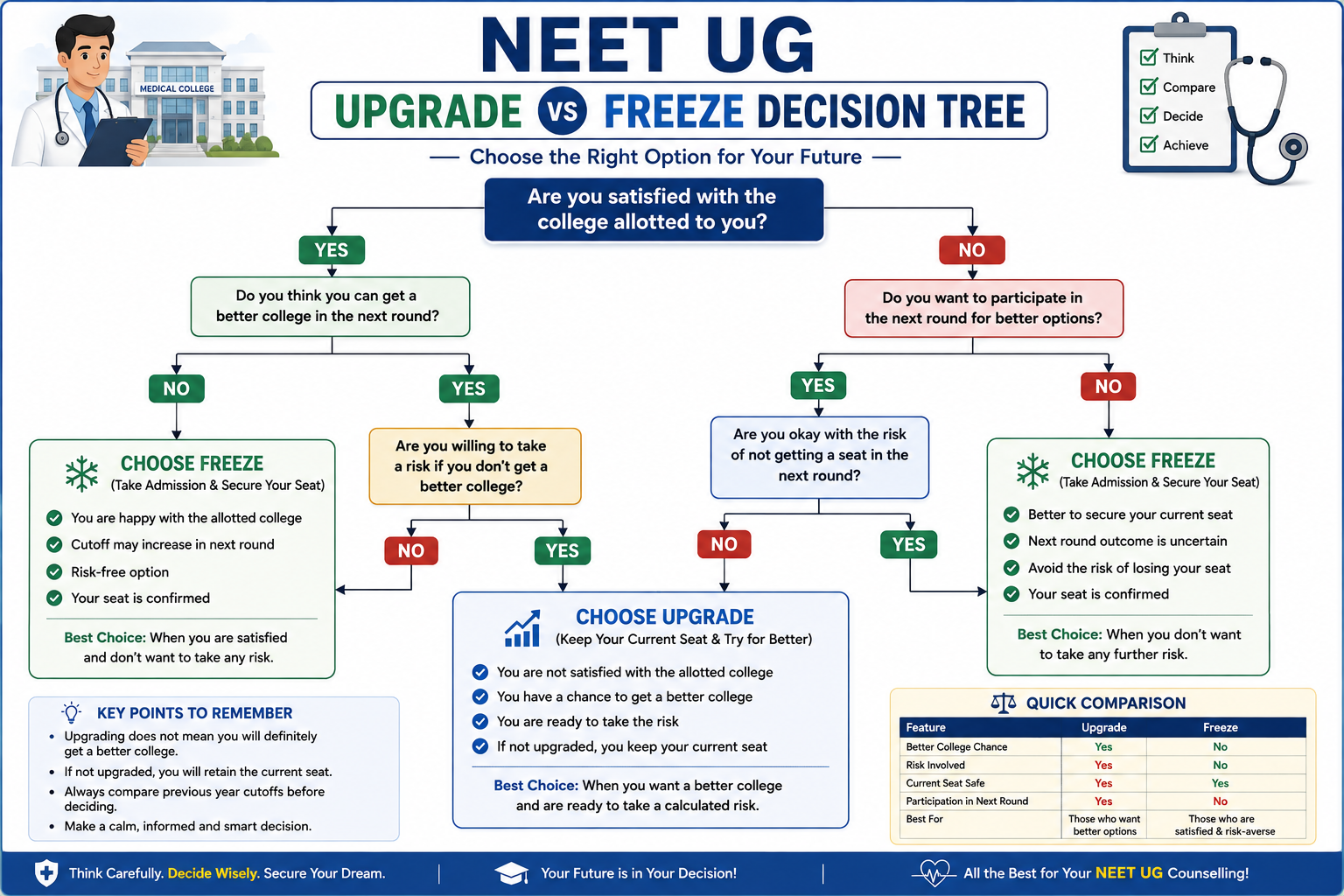
NEET UG Upgrade vs Freeze Decision Tree
Exit Options Explained
Candidates have specific exit options during counselling:
1. Free Exit:
- Available before final choice locking in any round
- No penalty or fee forfeiture
- Can participate in subsequent rounds
- Complete freedom to reconsider participation
2. Exit with Forfeiture:
- After seat allotment but before reporting
- Forfeit counselling fees and security deposit
- Cannot participate in subsequent rounds of same counselling
- May participate in other counselling processes
3. Willful Exit:
- After reporting and securing admission
- Forfeit all fees paid to the institution
- Written application required for exit
- Cannot participate in remaining rounds
Strategic Upgradation Tips
Round-wise Strategy:
- Round 1: Consider upgrade if significantly better options available
- Round 2: Be more selective as fewer seats available
- Mop Up: Generally freeze unless current seat is highly unsatisfactory
Risk Assessment:
- Analyze previous year trends for upgradation
- Consider the number of higher preferences
- Evaluate satisfaction level with current seat
- Factor in travel and adjustment issues
Expert Tip: Students from Punjab, Haryana, and Himachal Pradesh should consider local factors like distance from home, regional medical practice opportunities, and state-specific PG advantages while making upgrade decisions.
State-wise NEET Counselling Details
Each state conducts its own counselling for state quota seats with specific procedures, eligibility criteria, and reservation policies.
Punjab NEET Counselling
Punjab conducts counselling for 85% state quota seats in government and private medical colleges.
Conducting Authority: Baba Farid University of Health Sciences, Faridkot
Eligibility Criteria:
- Qualified NEET UG 2026
- Punjab domicile certificate, OR
- Studied classes 10, 11, 12 in Punjab, OR
- Parents working in Punjab for 15 years
Seat Matrix:
- Government Medical Colleges: 6 colleges
- Private Medical Colleges: 15+ colleges
- Total MBBS seats: Approximately 1,800
- Total BDS seats: Approximately 800
Reservation Policy:
- Scheduled Castes: 32%
- Backward Classes: 20%
- Border Area: 5%
- Sports Quota: 2%
- Freedom Fighters: 2%
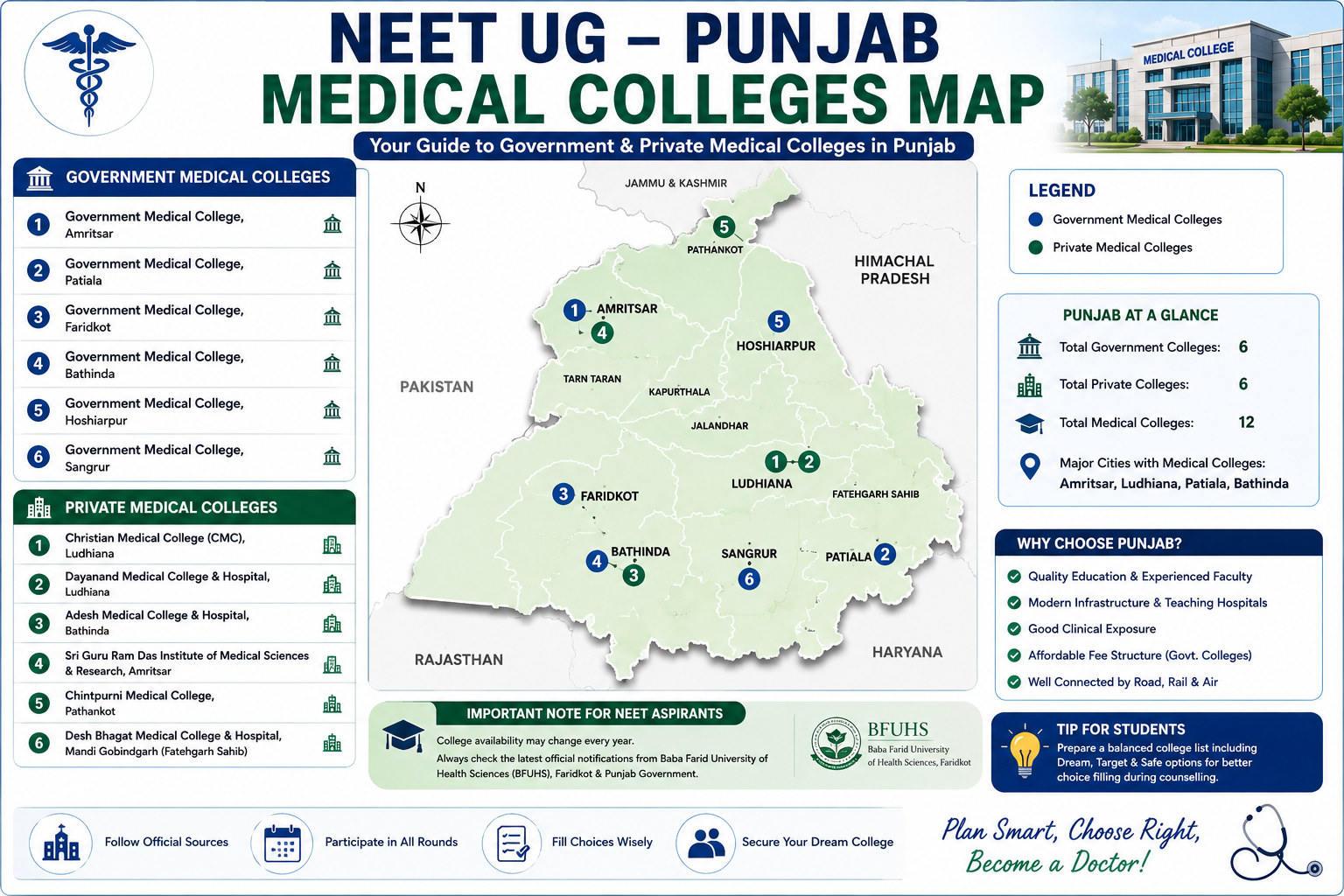
NEET UG Punjab Medical Colleges Map
Haryana NEET Counselling
Conducting Authority: Pt. B.D. Sharma University of Health Sciences, Rohtak
Key Features:
- Online counselling process
- Multiple rounds conducted
- Private college counselling included
- Management quota counselling separate
Domicile Categories:
1. Haryana Residents: 85% seats reserved
2. Non-resident Haryanvis: 15% of resident quota
3. Other State Candidates: Remaining seats if any
Major Medical Colleges:
- Pt. B.D. Sharma PGIMS, Rohtak
- Maharaja Agrasen Medical College, Agroha
- Kalpana Chawla Medical College, Karnal
- Adesh Medical College, Kurukshetra
Himachal Pradesh NEET Counselling
Conducting Authority: Himachal Pradesh University, Shimla
Unique Features:
- Tribal area reservations
- Border area benefits
- Ex-servicemen quota
- BPL category reservations
Eligibility Documents:
- Himachal Pradesh domicile certificate
- Category certificates (if applicable)
- Character certificate from school
- Medical fitness certificate
Medical Colleges:
- Indira Gandhi Medical College, Shimla
- Dr. Rajendra Prasad Medical College, Tanda
- Shri Lal Bahadur Shastri Medical College, Mandi
Delhi NEET Counselling
Conducting Authority: Directorate of Medical Education, Delhi
Special Provisions:
- Delhi University seats
- Maulana Azad Medical College
- ESIC Medical College inclusion
- Deemed university counselling
Rajasthan NEET Counselling
Major Advantage for North Indian Students:
- Large number of medical colleges
- Relatively lower cutoffs
- Good infrastructure in colleges
- Affordable fee structure
Seat Availability:
- 12+ Government medical colleges
- 25+ Private medical colleges
- 8+ Dental colleges
- RUHS University seats
Uttar Pradesh NEET Counselling
Largest State for Medical Seats:
- 30+ Government medical colleges
- 50+ Private medical colleges
- King George's Medical University
- AIIMS Gorakhpur and Rae Bareli
Advantages:
- Maximum seat availability
- Diverse college options
- Good connectivity from North India
- Established medical education system
State-wise Medical College Rankings
Private and Deemed University Counselling
Private and deemed universities offer additional opportunities for medical education, though at higher costs.
Deemed University Counselling Process
Deemed universities conduct their own counselling processes:
Popular Deemed Universities:
- Manipal Academy of Higher Education
- JSS Academy of Higher Education
- Kasturba Medical College
- Sri Ramachandra Institute
- BLDE University
Counselling Features:
- University-specific applications
- Separate fee structures
- Multiple quota systems
- Direct admission processes
Management Quota Admissions
Many private colleges reserve seats for management quota:
Characteristics:
- Higher fee structure
- Direct college admission
- NEET qualification mandatory
- Limited regulatory oversight
Application Process:
- Direct application to colleges
- Merit-based selection within quota
- Immediate admission possible
- Document verification at college
NRI Quota Counselling
Special provisions for NRI and OCI candidates:
Eligibility:
- NRI sponsored candidates
- OCI card holders
- Foreign nationals of Indian origin
- Specific percentage seats reserved
Fee Structure:
- USD-denominated fees
- Higher than domestic candidates
- Payment in foreign exchange
- Additional regulatory requirements
Counselling Timeline Coordination
Strategic Participation:
1. Government Counselling: First priority for most students
2. State Counselling: Parallel participation recommended
3. Private Counselling: Backup option preparation
4. Deemed University: Final safety net consideration
Important Note: Keep track of multiple counselling schedules simultaneously. Missing deadlines in any counselling reduces your overall admission opportunities.
Private Medical College Admission Guide
Common Mistakes to Avoid in NEET Counselling
Learning from common mistakes can significantly improve your counselling success rate and prevent costly errors.
Choice Filling Mistakes
1. Inadequate Research
Many students fill choices without proper college research:
- Not checking college infrastructure
- Ignoring faculty qualifications
- Missing accreditation status
- Overlooking hospital facilities
2. Unrealistic Expectations
Common unrealistic approaches:
- Filling only dream colleges
- Ignoring rank-appropriate choices
- Not including safety options
- Overestimating upgrade possibilities
3. Poor Choice Order
Strategic mistakes in choice arrangement:
- Random ordering without preference logic
- Mixing courses inappropriately
- Not prioritizing location preferences
- Ignoring fee structure implications
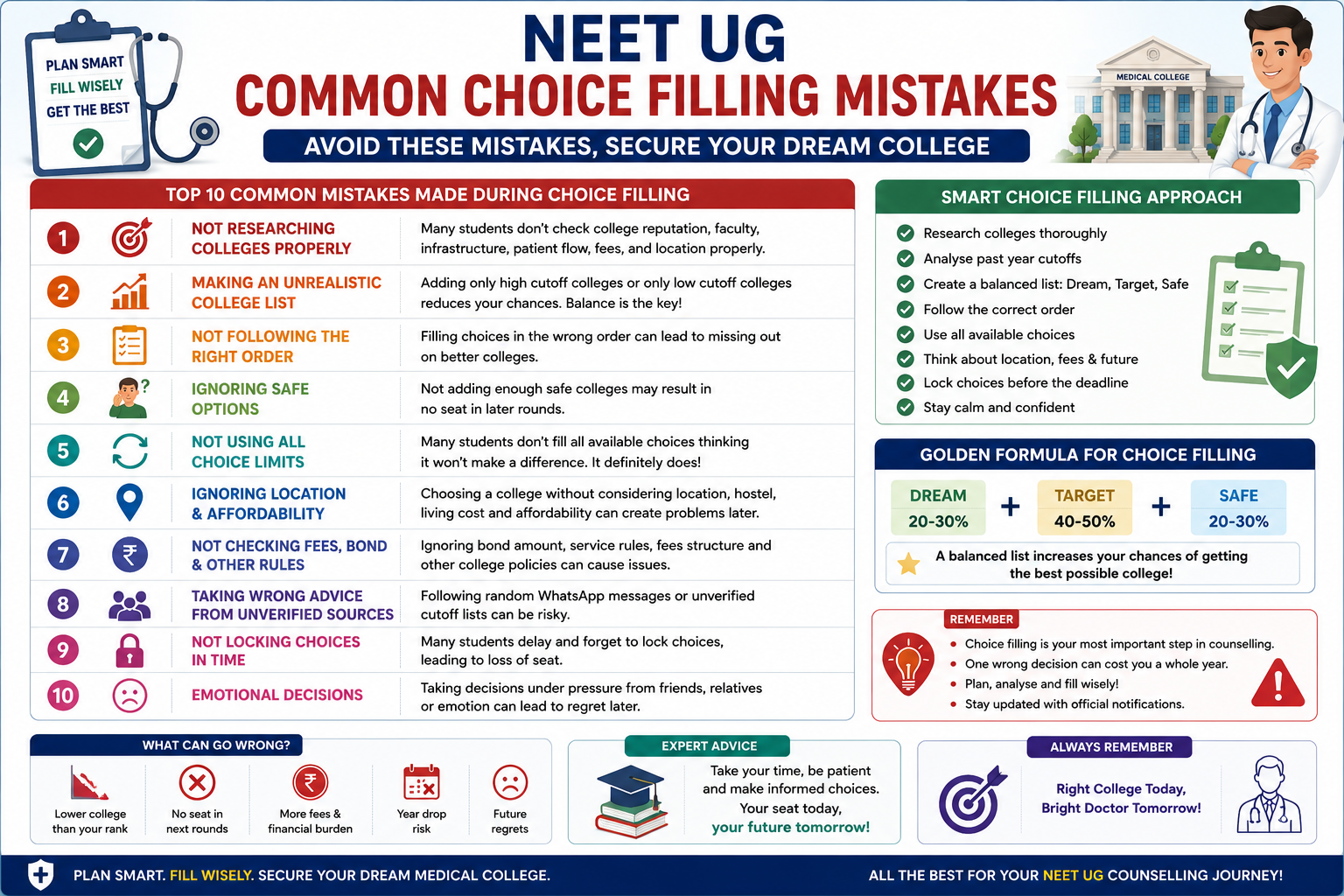
NEET UG Common Choice Filling Mistakes Infographic
Documentation Errors
1. Invalid Certificates
- Using expired caste certificates
- Submitting wrong category documents
- Missing mandatory attestations
- Poor quality scanned documents
2. Information Mismatch
- Different names across documents
- Date of birth inconsistencies
- Signature variations
- Address mismatches
3. Missing Documents
- Forgetting migration certificates
- Missing character certificates
- Incomplete mark sheet submissions
- Absent medical certificates for PWD
Registration and Process Mistakes
1. Late Registration
- Missing registration deadlines
- Delayed fee payments
- Last-minute document uploads
- Ignoring correction windows
2. Technical Issues
- Not keeping login credentials safe
- Ignoring browser compatibility
- Missing OTP verifications
- Not taking regular backups
3. Communication Gaps
- Providing wrong contact details
- Not updating mobile numbers
- Missing important notifications
- Ignoring official communications
Post-Allotment Mistakes
1. Delayed Reporting
- Not planning travel in advance
- Underestimating document preparation time
- Missing reporting deadlines
- Inadequate financial arrangements
2. Wrong Decision Making
- Panic decisions during upgradation
- Not researching allotted colleges properly
- Ignoring family consultation
- Making emotional rather than logical choices
Expert Tip: Create a detailed timeline and checklist for the entire counselling process. Many mistakes happen due to poor planning and time management rather than lack of information.
Financial Planning Mistakes
1. Inadequate Budget Planning
- Underestimating total education costs
- Not arranging emergency funds
- Poor loan application timing
- Ignoring hidden expenses
2. Payment Issues
- Not keeping sufficient bank balance
- Missing fee payment deadlines
- Using wrong payment methods
- Not saving payment receipts
Expert Tips for NEET Counselling Success
Successful counselling requires strategic planning, informed decision-making, and timely execution. Here are expert recommendations for maximizing your chances.
Pre-Counselling Preparation
1. Comprehensive Research
Start researching colleges immediately after NEET results:
- Create detailed college comparison sheets
- Analyze previous 3-5 years' cutoff trends
- Study college websites and facilities
- Connect with current students and alumni
2. Document Organization
Prepare all documents well in advance:
- Get multiple photocopies of all certificates
- Laminate important documents
- Create digital backups with cloud storage
- Organize documents in separate folders
3. Financial Preparation
Arrange finances before counselling begins:
- Apply for education loans early
- Research scholarship opportunities
- Keep liquid funds ready for immediate payments
- Understand fee structures of target colleges
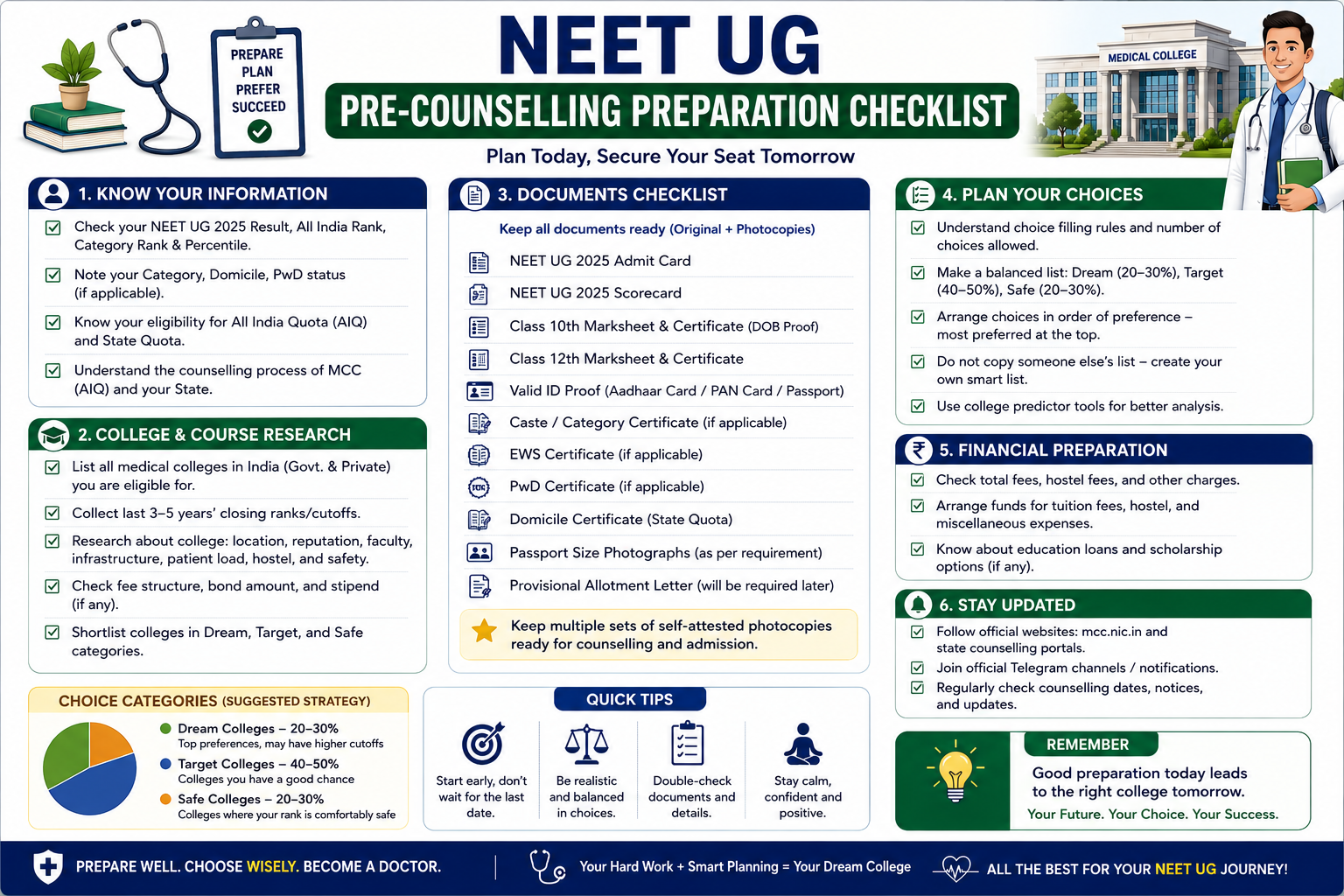
NEET UG Pre-Counselling Preparation Checklist
Strategic Choice Filling
1. Three-Tier Strategy
Divide your choices into three categories:
Aspiration Tier (30% choices):
- Dream colleges with excellent reputation
- Premier institutions with top rankings
- Colleges with outstanding infrastructure
- Institutions with high NEET PG success rates
Realistic Tier (50% choices):
- Colleges matching your rank range
- Good institutions with decent facilities
- Colleges with reasonable fee structures
- Institutions with acceptable locations
Safety Tier (20% choices):
- Colleges ensuring definite admission
- Last resort options to avoid year loss
- Colleges within financial constraints
- Institutions with basic accreditation
2. Location-wise Strategy
For students from North India, especially Chandigarh, Punjab, Haryana regions:
Local Advantages:
- Lower living costs
- Family support system
- Familiar cultural environment
- State PG examination benefits
Expansion Strategy:
- Consider Rajasthan colleges for better opportunities
- Explore UP colleges for diverse exposure
- Research Maharashtra colleges for quality education
- Evaluate Karnataka colleges for clinical exposure
Round-wise Counselling Strategy
Round 1 Strategy:
- Fill comprehensive choice list
- Include both safe and aspirational choices
- Research thoroughly before locking
- Choose upgrade if reasonable higher options exist
Round 2 Strategy:
- Analyze Round 1 results before choice modification
- Adjust expectations based on available seats
- Consider new colleges that participated
- Be more realistic in choice selection
Mop Up Round Strategy:
- Grab any available opportunity
- Consider deemed universities seriously
- Be flexible with location preferences
- Focus on securing admission over perfection
Technology and Process Tips
1. Technical Preparedness
- Use reliable internet connection
- Keep multiple devices ready
- Clear browser cache regularly
- Take screenshots of important pages
2. Time Management
- Don't wait for last-minute choice filling
- Lock choices at least 2 hours before deadline
- Keep buffer time for technical issues
- Plan verification and reporting schedules
3. Communication Strategy
- Save all important contact numbers
- Subscribe to official notifications
- Join reliable counselling groups
- Maintain regular portal checking routine
Decision Making Framework
1. College Evaluation Criteria
Create a scoring system for colleges based on:
- Academic reputation (30%)
- Infrastructure and facilities (25%)
- Location and accessibility (20%)
- Fee structure and affordability (15%)
- Future opportunities and placements (10%)
2. Course Selection Priority
Establish clear preferences:
- MBBS in good government college
- MBBS in average government college
- MBBS in good private college
- BDS in premier institution
- MBBS in average private college
Expert Tip: Don't let social pressure influence your decisions. Choose colleges based on your priorities, financial situation, and career goals rather than societal expectations or peer choices.
The guidance you receive during this crucial phase can make all the difference in your medical career journey. At NEET POINT Chandigarh, our experienced counselors help students navigate the complex counselling process with personalized guidance and up-to-date information.
NEET Counselling Guidance Services
Frequently Asked Questions (FAQs)
General NEET Counselling FAQs
Q1: What is NEET UG counselling and who conducts it?
NEET UG counselling is the admission process for medical and dental courses conducted by the Medical Counselling Committee (MCC) for All India Quota seats and by individual states for state quota seats. It allocates MBBS, BDS, AYUSH, and veterinary seats based on NEET UG scores and candidate preferences.
Q2: Can I participate in both AIQ and state counselling simultaneously?
Yes, eligible candidates can participate in both All India Quota counselling conducted by MCC and state quota counselling conducted by their respective states. This maximizes your chances of securing admission in medical colleges.
Q3: What is the difference between AIQ and state quota counselling?
AIQ counselling covers 15% seats in government colleges and 100% seats in central institutions without domicile restrictions. State quota covers 85% seats in government colleges and varies for private colleges with domicile requirements.
Q4: How many rounds are conducted in NEET counselling?
Typically, NEET counselling has 2-3 regular rounds followed by Mop Up rounds. The exact number may vary each year based on seat availability and candidate response. Some states also conduct additional stray vacancy rounds.
Q5: What documents are mandatory for NEET counselling registration?
Essential documents include NEET admit card and scorecard, class 10 and 12 certificates and mark sheets, date of birth certificate, category certificate (if applicable), Aadhaar card, and domicile certificate for state counselling.
Registration and Process FAQs
Q6: What is the fee structure for NEET counselling registration?
The counselling registration fee is typically ₹1,000 for General/EWS candidates and ₹500 for SC/ST/OBC/PWD candidates. This fee is separate from college admission fees and is non-refundable.
Q7: Can I change my choices after locking them?
No, once you lock your choices or the deadline passes (automatic locking), you cannot modify your choice list. However, you can fill fresh choices in subsequent rounds if you remain eligible.
Q8: What happens if I don't report after seat allotment?
If you don't report within the specified timeline, you forfeit the allotted seat and cannot participate in subsequent rounds of the same counselling. You may still be eligible for other counselling processes.
Q9: Is there any negative marking or penalty for participating in counselling?
There's no negative marking for participating in counselling. However, you forfeit the registration fee if you don't secure admission, and additional penalties apply if you exit after reporting to an allotted college.
Q10: Can I get admission without participating in counselling?
No, participation in authorized counselling is mandatory for admission to medical and dental courses. Direct admissions without counselling are not valid and may lead to cancellation of admission.
Choice Filling and Strategy FAQs
Q11: How many choices should I fill in NEET counselling?
There's no specific limit, but it's recommended to fill 100-150 choices to maximize admission chances. Include choices across different preference levels - aspiration, realistic, and safety options.
Q12: Should I fill BDS choices if I want only MBBS?
If you're open to dental career, include BDS choices from good colleges. However, if you're determined to pursue only MBBS, you may skip BDS choices and try again next year if needed.
Q13: Can I change my category during counselling?
No, you cannot change your category during counselling. The category is fixed based on your NEET application and uploaded certificates during registration.
Q14: What is the best strategy for choice filling?
Fill choices in genuine preference order, research colleges thoroughly, include a mix of government and private colleges, consider location and fee factors, and don't leave any realistic option unfilled.
Q15: Should I consider colleges in other states?
Yes, considering colleges in other states increases your options significantly. Many students from North India successfully study in colleges across Rajasthan, UP, Maharashtra, and Karnataka.
Seat Allotment and Upgradation FAQs
Q16: How does the seat allotment algorithm work?
The algorithm processes candidates rank-wise, checks their choice list sequentially, and allocates the highest available preference that matches their eligibility and seat availability.
Q17: What is upgradation and when should I choose it?
Upgradation allows you to secure your current seat while remaining eligible for better options in subsequent rounds. Choose it when you have significantly higher preferences that might be available later.
Q18: Can I get a seat in a college I didn't fill as a choice?
No, you can only get seats from colleges you've filled as choices. The algorithm only considers your submitted preference list for allocation.
Q19: What is the difference between 'Freeze' and 'Upgrade' options?
Freeze means you accept the current seat and exit counselling permanently. Upgrade means you secure the current seat but remain eligible for better options in subsequent rounds.
Q20: Can my allotted seat be cancelled after reporting?
Yes, seats can be cancelled during document verification if you don't meet eligibility criteria, submit invalid documents, or violate admission guidelines. Always ensure document authenticity.
State-specific and Category FAQs
Q21: What is domicile requirement for state counselling?
Domicile requirements vary by state. Generally, it requires continuous residence or study in the state for specified periods. Check specific state guidelines for exact criteria.
Q22: Can I apply for domicile certificate during counselling?
Domicile certificate application processes vary by state and typically take time. It's advisable to apply well before counselling begins to avoid last-minute issues.
Q23: What is the reservation policy in medical counselling?
Central counselling follows constitutional reservations: SC (15%), ST (7.5%), OBC-NCL (27%), EWS (10%), and PWD (5%). States may have additional reservations.
Q24: Do I need separate applications for different state counsellings?
Yes, each state conducts its own counselling with separate applications, though the basic eligibility remains the same. Monitor multiple state websites for announcements.
Q25: What is the eligibility for EWS category?
EWS eligibility requires annual family income below ₹8 lakhs and not owning specified agricultural land or property. Valid income and asset certificates are mandatory.
Financial and Practical FAQs
Q26: What is the fee structure in government medical colleges?
Government medical college fees typically range from ₹50,000 to ₹1,50,000 annually for MBBS, varying by state. Additional costs include hostel, mess, books, and miscellaneous expenses.
Q27: Can I get education loan for medical studies?
Yes, banks provide education loans up to ₹1.5 crores for medical studies. Interest rates range from 8.5% to 12% annually. Repayment typically starts after course completion plus one year.
Q28: What are the additional costs besides tuition fees?
Additional costs include hostel fees (₹15,000-40,000), mess charges (₹2,000-4,000 monthly), books and equipment (₹50,000-1,00,000), and miscellaneous expenses (₹20,000-50,000 annually).
Q29: Are there scholarships available for medical students?
Yes, various scholarships are available including government scholarships for SC/ST/OBC students, merit scholarships, state-specific scholarships, and private foundation scholarships.
Q30: What happens if I can't pay fees on time?
Late fee payment may result in seat cancellation. Contact the college administration immediately if facing payment issues. Some colleges offer installment facilities or extension under special circumstances.
Technical and Process FAQs
Q31: What browser should I use for counselling registration?
Use updated versions of Chrome, Firefox, or Edge browsers. Disable pop-up blockers, clear cache regularly, and ensure stable internet connection throughout the process.
Q32: Can I use mobile phone for counselling registration?
While mobile registration is possible, it's recommended to use desktop or laptop for better interface and document upload ease. Keep mobile as backup option only.
Q33: What if I face technical issues during registration?
Contact the helpline immediately, take screenshots of error messages, try different browsers or devices, and keep attempting within the deadline. Technical issues are usually resolved quickly.
Q34: How do I know if my registration is successful?
You'll receive confirmation emails and SMS on registered contact details. Login to your account regularly to check status updates and download registration confirmation.
Q35: What is the validity of NEET scores for counselling?
NEET UG scores are valid only for the same academic year. You cannot use previous year NEET scores for current year counselling processes.
College and Course Specific FAQs
Q36: Which are the best government medical colleges in India?
Top government colleges include AIIMS Delhi, AFMC Pune, JIPMER Puducherry, King George's Medical University Lucknow, and various state medical colleges like Seth GS Medical College Mumbai.
Q37: What is the difference between medical college and deemed university?
Medical colleges are typically affiliated with universities and follow university curricula. Deemed universities have autonomy in curriculum design and examination patterns while maintaining NMC standards.
Q38: Can I transfer from one medical college to another?
Transfer between medical colleges is generally not permitted as per NMC regulations. In exceptional cases, transfers may be considered through proper channels with valid reasons.
Q39: What is the MBBS course duration and structure?
MBBS is a 5.5-year course including 4.5 years of academic study and 1 year of compulsory rotating internship. The curriculum includes pre-clinical, para-clinical, and clinical subjects.
Q40: Are private medical colleges worth the high fees?
Private colleges can be worth it if they offer good infrastructure, faculty, and clinical exposure. However, consider your financial capacity and compare with available government college options.
Counselling Rounds and Timeline FAQs
Q41: When does NEET counselling typically start?
NEET counselling usually begins 2-3 weeks after result declaration, typically in July-August. Exact dates are announced by MCC and respective state authorities based on the academic calendar.
Q42: How long does the entire counselling process take?
The complete counselling process typically spans 2-3 months, including all rounds, mop-up rounds, and state counsellings. Individual rounds usually take 2-3 weeks from choice filling to reporting.
Q43: Can I participate in counselling if I join late?
You can participate from any available round if registration is open. However, seat availability decreases in later rounds, so early participation is always better.
Q44: What is the difference between regular rounds and mop-up rounds?
Regular rounds are the primary counselling phases with maximum seat availability. Mop-up rounds are conducted for remaining vacant seats and often include deemed universities and additional colleges.
Q45: Are counselling dates the same across all states?
No, each state conducts counselling as per their schedule. While some coordination exists to avoid clashes, dates may overlap. Monitor multiple counselling schedules simultaneously.
Specific Situations and Special Cases FAQs
Q46: Can NRI candidates participate in NEET counselling?
Yes, NRI candidates can participate in counselling for NRI quota seats in various colleges. They need to fulfill specific eligibility criteria and often pay higher fees in foreign currency.
Q47: What if I have a gap year after 12th standard?
Gap years are generally acceptable, but you may need to submit a gap year affidavit explaining the reason. Some colleges or states may have specific policies regarding gap years.
Q48: Can I participate in counselling with compartment results?
No, you must have passed all subjects in 12th standard to be eligible for counselling. Compartment or improvement exam results are not accepted for medical admissions.
Q49: What if my NEET scorecard has errors?
Contact NTA immediately to get scorecard errors corrected. Participate in counselling only after getting the corrected scorecard, as incorrect information may lead to disqualification.
Q50: Can I change my personal details during counselling?
Minor corrections may be possible during correction windows, but major changes are generally not allowed. Ensure all details match your NEET application and supporting documents.
Career and Future Planning FAQs
Q51: Which medical colleges have best NEET PG results?
Colleges with strong academic culture, experienced faculty, and good library facilities typically produce better NEET PG results. Research specific college statistics and talk to alumni.
Q52: Should I prefer MBBS in private college or drop a year?
This depends on your financial situation, age, confidence level, and family circumstances. Consider the opportunity cost of losing a year versus the financial burden of private college fees.
Q53: What are the career opportunities after MBBS?
MBBS graduates can pursue postgraduate specialization, practice as general physicians, work in government services, join healthcare organizations, or explore medical research and teaching careers.
Q54: Is location important for medical college selection?
Location affects living costs, cultural adjustment, language barriers, family support, and future practice opportunities. Balance location preferences with college quality and opportunities.
Q55: How important are college rankings for medical education?
Rankings provide general guidance, but focus on specific factors like faculty qualifications, hospital infrastructure, research opportunities, and student feedback rather than just overall rankings.
Documentation and Verification FAQs
Q56: What if my caste certificate is expired?
Expired certificates are not accepted in counselling. Get your caste certificate renewed well before counselling begins to avoid last-minute issues and potential disqualification.
Q57: Can I use digital/scanned copies of documents?
Digital copies are used for online registration and verification. However, original documents are mandatory during physical verification at the time of admission.
Q58: What if there's a name mismatch in my documents?
Minor spelling variations may be acceptable, but significant name mismatches can cause problems. Get an affidavit or correction certificate from appropriate authorities if needed.
Q59: Is signature verification mandatory during counselling?
Yes, signatures are verified during document verification. Maintain consistency in signatures across all documents and during the counselling process.
Q60: What if I don't have all required documents?
Missing mandatory documents lead to disqualification. Start document preparation immediately after NEET results and contact issuing authorities well in advance for any missing certificates.
Admission and Reporting FAQs
Q61: What happens during college reporting after seat allotment?
Reporting involves document verification, original document submission, fee payment, admission form completion, and completing other college-specific formalities within the specified timeline.
Q62: Can I report to college through a representative?
Generally, personal reporting is mandatory. Some colleges may allow representative reporting in exceptional circumstances with proper authorization and documentation.
Q63: What if I fall sick during the reporting period?
Contact the college administration immediately and provide medical certificates. Many colleges provide extensions for genuine medical emergencies with proper documentation.
Q64: Is hostel accommodation guaranteed after admission?
Hostel accommodation is not guaranteed and is usually allocated on first-come-first-served basis. Apply for hostel immediately after admission and arrange alternative accommodation as backup.
Q65: What documents do I need to carry during college reporting?
Carry all original documents submitted during registration, multiple photocopies, photographs, migration certificate, character certificate, medical fitness certificate, and anti-ragging affidavit.
Financial Planning and Scholarships FAQs
Q66: What scholarships are available for medical students?
Scholarships include central government scholarships (SC/ST/OBC/Minority), state scholarships, merit-based scholarships, private foundation scholarships, and college-specific scholarships.
Q67: How do I apply for education loans for medical studies?
Approach banks with NEET scorecard, admission letter, fee structure, academic records, income proof, and collateral documents. Compare interest rates and terms across different banks.
Q68: Can I work part-time during MBBS to support expenses?
Medical education is intensive and requires full-time commitment. Part-time work is generally not recommended and may affect academic performance. Focus on scholarships and loans instead.
Q69: What is the total cost of medical education in India?
Total costs vary significantly: Government colleges (₹5-15 lakhs), Private colleges (₹50-150 lakhs), Deemed universities (₹75-200 lakhs) including tuition, hostel, books, and living expenses.
Q70: Are there any tax benefits for medical education expenses?
Yes, education loan interest payments qualify for tax deductions under Section 80E. Additionally, tuition fee payments may qualify for deductions under Section 80C with specified limits.
State-wise Specific FAQs
Q71: What are the advantages of studying in Punjab medical colleges?
Punjab colleges offer quality education with moderate fees, good clinical exposure, cultural familiarity for North Indian students, and benefits for state PG examinations for domicile holders.
Q72: Can students from other states get admission in Haryana medical colleges?
Yes, through AIQ counselling for 15% seats and remaining seats if available after accommodating Haryana domicile candidates in state counselling.
Q73: What is the process for Himachal Pradesh medical college admissions?
HP conducts state counselling for domicile candidates with reservations for tribal areas, ex-servicemen, and other categories. Non-domicile candidates can apply through AIQ counselling.
Q74: Are there language barriers in medical colleges outside North India?
While medical education is in English, regional language knowledge helps in patient interaction during clinical years. Many colleges provide language support for outstation students.
Q75: Which states offer best opportunities for North Indian medical students?
Rajasthan, UP, Haryana, Punjab, Delhi, and Himachal Pradesh offer good opportunities with cultural familiarity, while Karnataka, Maharashtra, and Tamil Nadu provide excellent clinical exposure.
Course and Curriculum FAQs
Q76: What is the difference between MBBS and BDS career prospects?
MBBS offers broader medical practice opportunities, while BDS provides specialized dental practice. Both have good career prospects, but MBBS generally offers more diverse opportunities.
Q77: Can I change from MBBS to BDS or vice versa after admission?
Course changes are generally not permitted after admission. You would need to participate in fresh counselling for the desired course in subsequent years.
Q78: What are AYUSH courses and their career prospects?
AYUSH includes BAMS (Ayurveda), BHMS (Homeopathy), BUMS (Unani), and BSMS (Siddha). These offer alternative medicine career paths with growing acceptance and government support.
Q79: Is the MBBS curriculum same across all medical colleges?
The basic curriculum follows NMC guidelines, but colleges may have variations in teaching methods, assessment patterns, and additional training programs while maintaining core standards.
Q80: What clinical exposure can I expect during MBBS?
Clinical exposure begins from the third year with patient interaction, case studies, ward rounds, OPD duties, and hands-on training in various medical specialties under faculty supervision.
Technology and Online Process FAQs
Q81: Is online counselling as reliable as offline counselling?
Online counselling is secure, transparent, and efficient when conducted by authorized bodies. It reduces travel costs and time while maintaining fairness and accessibility.
Q82: What if I lose my counselling login credentials?
Use the 'Forgot Password' option with registered mobile number and email. Contact helpline if issues persist. Keep credentials secure and avoid sharing with anyone.
Q83: Can I download my counselling application form after submission?
Yes, you can download and print your application form, choice list, allotment letter, and other documents from your counselling account. Keep multiple copies for records.
Q84: What internet speed is required for smooth counselling process?
A stable broadband connection with at least 2 Mbps speed is recommended. Avoid peak hours for better connectivity and keep mobile data as backup.
Q85: Are there any mobile apps for NEET counselling?
Some states provide official mobile apps for counselling updates. However, complete registration and choice filling are better done through official websites on computers.
Counselling Support and Guidance FAQs
Q86: Should I take professional counselling guidance?
Professional guidance can be helpful for understanding complex processes, making strategic choices, and avoiding common mistakes, especially if you're unfamiliar with the counselling system.
Q87: How do I identify genuine counselling consultants?
Choose consultants with proven track records, transparent fee structures, official registrations, positive student feedback, and ethical practices. Avoid those promising guaranteed admissions.
Q88: What role do parents play in counselling decisions?
Parents provide emotional support, financial planning, and mature perspective. However, career decisions should primarily align with student's interests, aptitude, and long-term goals.
Q89: How important is peer advice during counselling?
Peer experiences can provide practical insights, but remember that each candidate's situation is unique. Make decisions based on your specific circumstances rather than following others blindly.
Q90: Where can I get authentic information about counselling?
Rely on official websites (MCC, NTA, State authorities), government notifications, official helplines, and verified educational consultants. Avoid unverified social media information.
Future Planning and Career FAQs
Q91: What should I do if I don't get admission in any medical college?
Consider dropping for another attempt, exploring alternative healthcare courses (pharmacy, physiotherapy, nursing), preparing for other competitive exams, or pursuing related degree courses.
Q92: How do I prepare for medical college academics after admission?
Focus on building strong foundation knowledge, developing study habits, improving communication skills, and preparing mentally for intensive academic schedules and patient interaction.
Q93: What are the opportunities for medical research during MBBS?
Many colleges offer research opportunities through faculty projects, student research programs, conferences, and publications. Active participation enhances learning and career prospects.
Q94: Can I pursue postgraduate studies abroad after Indian MBBS?
Yes, Indian MBBS is recognized globally, but you may need to clear licensing exams like USMLE (USA), PLAB (UK), or AMC (Australia) depending on the destination country.
Q95: What specialization options are available after MBBS?
MBBS graduates can specialize in various fields through NEET PG including internal medicine, surgery, pediatrics, gynecology, psychiatry, radiology, anesthesia, and many other specialties.
Final Preparation and Success FAQs
Q96: What final preparations should I make before counselling?
Complete document preparation, financial arrangements, college research, choice list planning, technical setup for online processes, and mental preparation for quick decision-making.
Q97: How do I stay updated with counselling notifications?
Subscribe to official websites, enable SMS and email notifications, join authentic counselling groups, follow official social media accounts, and check portals regularly.
Q98: What mindset should I maintain during counselling?
Stay positive, flexible, and realistic. Be prepared for multiple scenarios, make informed decisions rather than emotional ones, and remember that any medical college admission is an achievement.
Q99: How do I handle stress and anxiety during counselling?
Maintain regular sleep schedules, eat healthy, exercise lightly, practice meditation, talk to family and friends, seek professional help if needed, and focus on controllable factors.
Q100: What is the most important advice for NEET counselling success?
Start preparation early, research thoroughly, fill choices strategically, keep all options open, maintain document authenticity, follow timelines strictly, and make informed decisions based on your priorities and circumstances rather than external pressures.
Conclusion: Your Journey to Medical Education Success
NEET UG Counselling 2026 represents the culmination of years of hard work and the beginning of your medical career journey. This comprehensive guide has covered every aspect of the counselling process, from basic understanding to advanced strategies, ensuring you're well-prepared to navigate this crucial phase successfully.
The key to counselling success lies in thorough preparation, strategic thinking, and timely execution. Remember that counselling is not just about securing any medical seat—it's about finding the right fit for your career aspirations, financial situation, and personal circumstances. Whether you're aiming for prestigious government colleges or considering private institutions, every medical college offers opportunities to build a meaningful healthcare career.
Key Takeaways for Success
Your counselling journey should be guided by informed decision-making rather than panic or external pressure. Research colleges thoroughly, understand the fee structures, analyze location factors, and most importantly, fill choices based on your genuine preferences. The systematic approach outlined in this guide—from documentation to choice filling, from upgradation decisions to final reporting—will help you avoid common pitfalls and maximize your admission chances.
For students from Chandigarh, Punjab, Haryana, Himachal Pradesh, and across North India, the opportunities in medical education have never been better. With proper guidance and strategic planning, you can secure admission in colleges that align with your career goals and family circumstances.
Moving Forward with Confidence
As you embark on this counselling journey, remember that professional guidance can make a significant difference in outcomes. At NEET POINT Chandigarh, we've been helping students navigate the complex counselling process with personalized support, updated information, and proven strategies. Our experienced counselors understand the nuances of both central and state counselling processes, helping students make informed decisions at every step.
The medical profession awaits dedicated students who are willing to serve humanity with knowledge, compassion, and skill. Your NEET qualification has opened the door—now it's time to step through it with confidence and determination.
Whether you secure admission in your dream college or find success in an unexpected opportunity, remember that your dedication and hard work during the MBBS course will ultimately define your medical career success. Every renowned doctor today once stood where you stand now, ready to begin their medical education journey.
Take Action Today: Start your counselling preparation immediately, organize your documents, research your target colleges, and prepare for the exciting journey ahead. Your future patients are waiting for the skilled, compassionate doctor you're destined to become.
Start Your NEET Counselling Guidance Journey
Best wishes for your NEET UG Counselling 2026 and your future medical career.
This comprehensive guide serves as your roadmap to NEET counselling success. For personalized guidance, updated information, and expert counseling support, connect with experienced educational consultants who can help you make the best decisions for your medical career.